




Port Crane Structural Inspection: What Terminal Operators Need to Know
September 02,2026
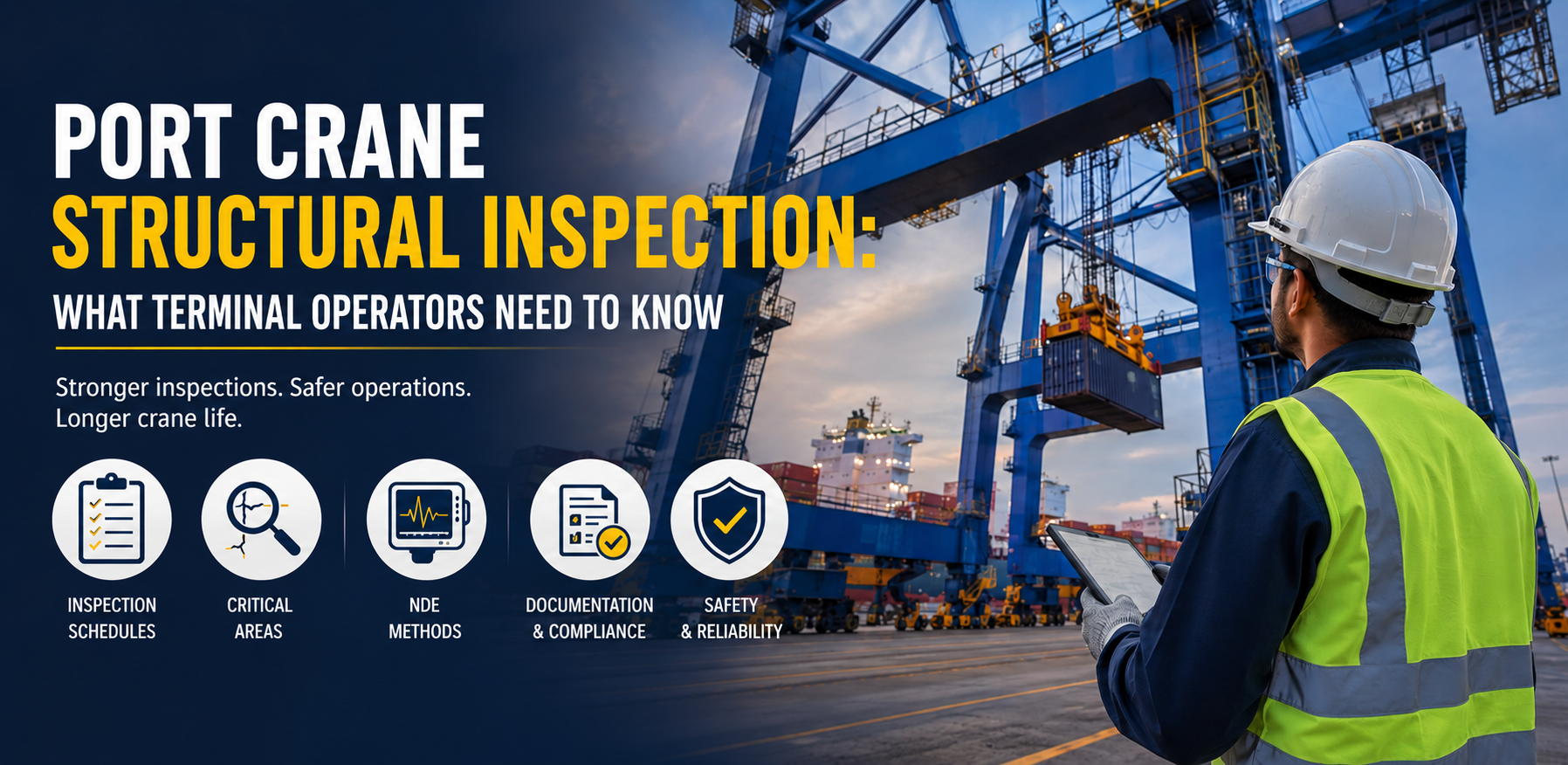
Every port crane on your terminal is carrying more than containers. Its portal legs, boom hinges, and trolley girders are absorbing dynamic loads thousands of times a day, in a marine environment that eats away at steel faster than most inland equipment ever experiences. Over years of continuous operation, that combination of cyclic stress and salt-air corrosion is exactly what structural inspection programmes exist to catch long before it becomes a crane that's out of service, or worse, a safety incident.
For terminal operators, port crane structural inspection is a compliance-critical, safety-first discipline that blends quick daily checks by operators with deeper, standards-based examinations from certified inspectors. Get the cadence and the scope right, and you extend crane life, avoid unplanned downtime, and keep regulators (and insurers) satisfied. Get it wrong, and small fatigue cracks quietly become expensive structural failures.
Here's what a well-run inspection programme actually looks like.
| Inspection type | Typical frequency | Who performs it | What it covers |
|---|---|---|---|
| Pre-shift / daily | Every shift | Operator or designated person | Visual checks of controls, safety devices, obvious structural damage, leaks, and wire rope condition |
| Frequent / periodic | Monthly to quarterly | Designated inspector | Closer look at functional components and accessible structural features |
| Annual thorough examination | Every 12 months | Competent/certified inspector | Detailed structural and mechanical inspection, NDE testing where needed, load testing, and certification |
| Quadrennial | Every 4 years | Certified inspector | Enhanced structural survey with more extensive NDE and compliance documentation |
| Five-year comprehensive | Every 5 years (API 2C cranes) | Specialist surveyor | Full NDE of primary welds, hydraulic pressure testing, slew bearing inspection, and a 110% load test |
Skipping a tier to save a shift's downtime is usually a false economy. Most structural failures trace back to a defect that was visible at an earlier inspection stage but never escalated.
Where Structural Failures Actually Start
Not every part of a crane carries equal risk. If you're prioritizing inspection time and NDE budget, these are the areas that see the most fatigue and deserve the closest attention:
• Portal legs and sill beams. The leg-to-sill joints absorb dynamic loads every time the crane travels or handles a container, which makes them a common site for fatigue cracking at the welds.
• Boom and boom hinge connections. Hinge pins, bushings, and connection plates take repeated cyclic stress, so wear, cracking, and deformation tend to show up here first.
• Trolley girders and rails. A single STS crane can rack up millions of load cycles a year, and that shows in rail misalignment, girder deflection, and web plate cracking over time.
• Backstay and forestay connections. Paint cracking, rust staining, and deformation at tension rods, gusset plates, and pin connections are early warning signs worth flagging, not ignoring.
• A-frame and machinery house mounts. These structural connections are prone to crack propagation and loosening under sustained vibration.
• Coating and corrosion. In a marine environment, coating failure and rust bloom are the entry point for section loss. Ultrasonic thickness (UT) testing at critical members quantifies exactly how much material has been lost.
The Inspection Methods Worth Knowing
Visual inspection is where every check starts, but it can't catch what's happening beneath the surface. That's where non-destructive examination (NDE) comes in:
• Visual inspection – systematic walkdowns, checklists, photo documentation, and defect tagging
• Ultrasonic Testing (UT) – measures remaining wall thickness and picks up subsurface flaws in critical members
• Magnetic Particle Inspection (MPI) – finds surface and near-surface cracks in ferromagnetic components like pins and castings
• Magnetic Flux Leakage (MFL) – used on wire ropes to detect internal and external degradation per ISO 4309
• Oil analysis and vibration monitoring – flags early mechanical degradation in gearboxes and rotating equipment before it becomes a bigger problem
A programme that leans on visual checks alone will always miss subsurface fatigue. The NDE layer is what turns "looks fine" into "verified fine."
Documentation That Actually Holds Up in an Audit
An inspection that isn't documented properly is hard to defend — to a regulator, an insurer, or your own maintenance team six months later. At minimum, terminal operators should be keeping:
• Inspection reports with findings, photos, measurements (UT thickness readings included), and corrective actions taken
• Load test certificates, kept on-site, from initial installation and every periodic examination since
• A deficiency tracking log that assigns priority to defects and tracks them through to closure
• Personnel certification records confirming inspectors and operators are trained per the relevant standards, depending on the jurisdiction
Making the Inspection Programme Work in Practice
A few habits separate terminals that run inspection programmes smoothly from those that are constantly catching up:
• Standardize your checklists so every inspector in-house or contracted is working from the same digital format aligned with OSHA, ASME, or ISO requirements. It makes audits faster and inspections more consistent.
• Put your NDE budget where the fatigue actually happens. Boom hinges and trolley girders earn more frequent testing than lower-stress components.
• Connect inspection findings to your CMMS so defects turn into scheduled work orders automatically, instead of living in a spreadsheet no one revisits.
• And don't treat coating inspection as optional in a marine environment salt corrosion moves faster than most maintenance calendars assume, so high-exposure areas need more frequent UT checks, not the standard interval.
Why This Discipline Pays Off
A structured, standards-compliant inspection programme isn't just about compliance paperwork. It's what keeps cranes running, keeps people safe, and keeps unplanned downtime off your books. The terminals that treat structural inspection as a genuine engineering discipline, not a checkbox, are the ones that get the most productive years out of every crane on the yard.